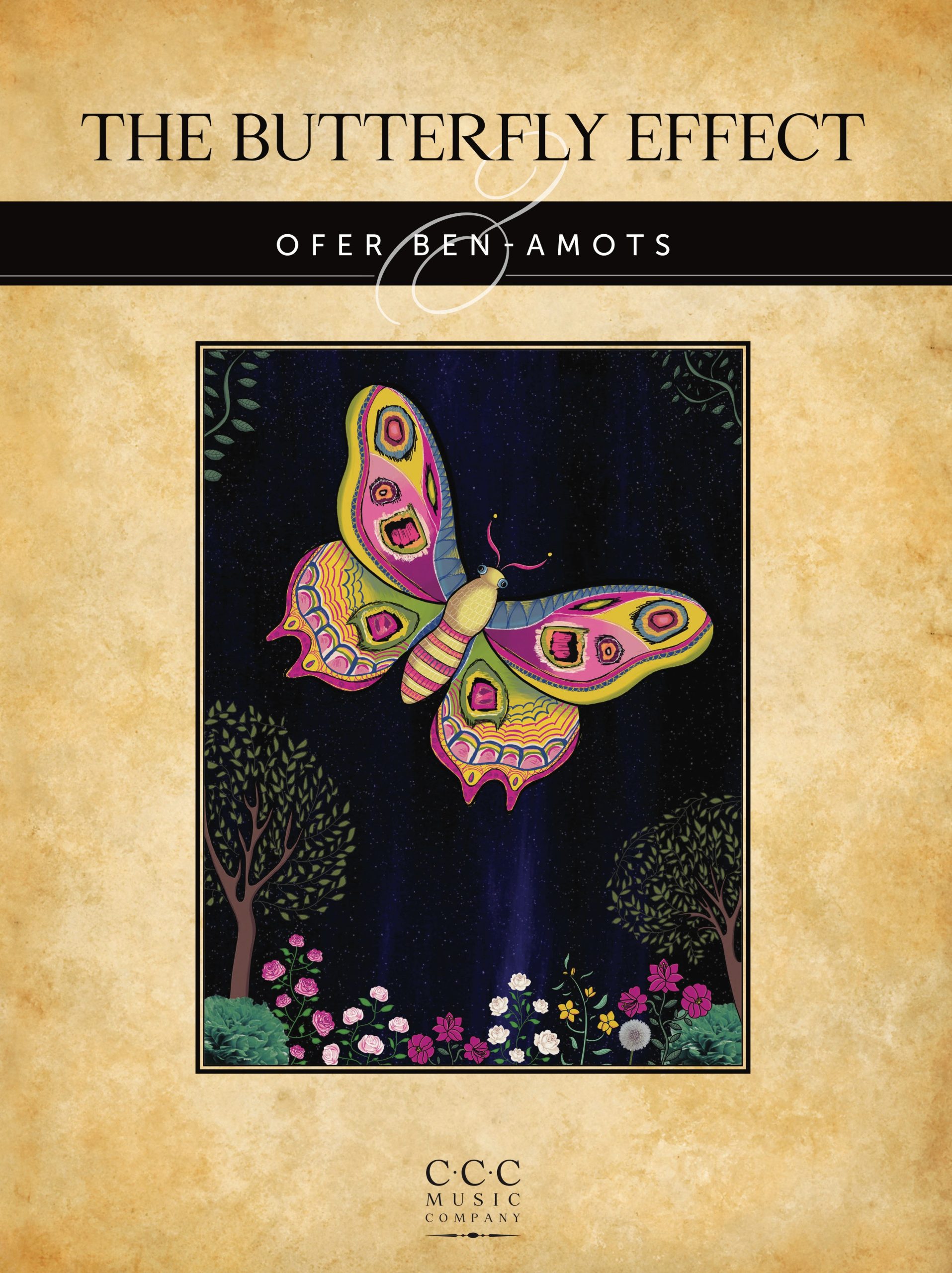
The Butterfly Effect
$5.99
he Butterfly Effect is part of a solo piano trilogy (a set of three works) written during the Covid-19 pandemic as a creative response to the rare and prolonged lockdown experience. The initial idea for this piece emerged a year earlier, when my dear friend, the Spanish pianist and brilliant mathematician Laura Farré Rozada, asked me to compose a piece based on the Fibonacci numerical series. Pondering about the Fibonacci numbers brought some distant memories of a seminal book that deeply impressed me in my youth: Gödel, Escher, Bach: An Eternal Golden Braid, by Douglas R. Hofstadter. Several sections in this book dealt with ‘order and chaos’ and delved into chaos theory. Linking the Fibonacci Series to the chaos numerical theory was just a short way to the Butterfly Effect metaphor. The idea that a small, almost unnoticeable motion of gentle butterfly’s wings at one part of the world can cause – through a chain of natural events and reactions – a large explosion, a tsunami, or utter chaos at another part of the world, became intriguing to me. Furthermore, the immediate association, that the pandemic started as a minor occurrence somewhere in Eastern Asia and that within just a few months it brought the entire world onto its knees through an immeasurable crisis, showed a striking similarity to the Butterfly Effect in action. This fascinating concept has been as arbitrary as it was predictable, and as the world is still trying to recover from it, the backdrop of this story-imagery idea became the conceptual basis for the composition.
The piece is also inspired and informed by the Fibonacci number series. While the use of the mathematical series is free associative, the Fibonacci series is loosely integrated into all aspects of the composition: the melodic-motivic patterns, the harmonic structure, rhythmic patterns, meter signatures, and tempo indications. Sometimes it can be found in the number of notes in a specific pattern, or in the number of measures. Nonetheless, it is suggested to enjoy the music without focusing too much on the mathematical patterns.